3D printer nozzle quick answer
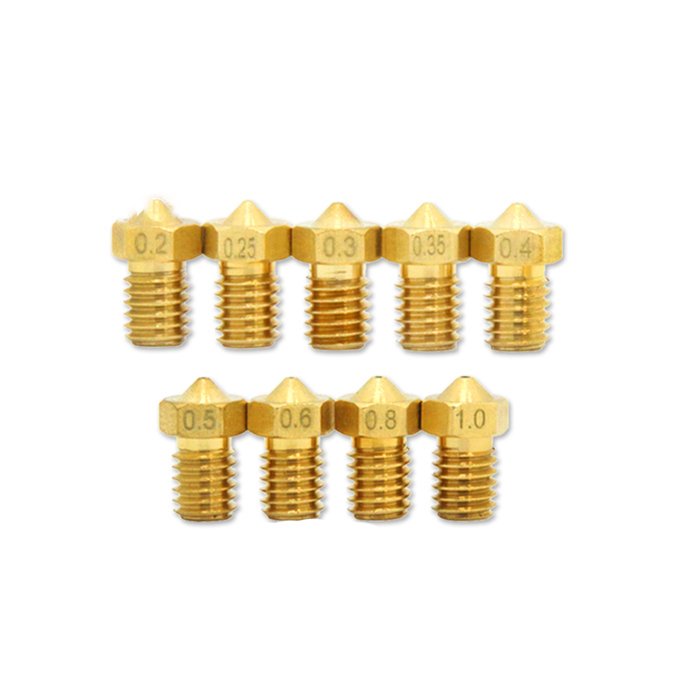
Choose a nozzle by hotend family, thread type, nozzle length, filament diameter, nozzle diameter, and material. A 0.4 mm brass nozzle is a common general-purpose choice, but abrasive filaments usually need hardened steel or another wear-resistant material.
Why nozzle diameter, thread, and material matter
A nozzle is small, inexpensive, and easy to underestimate. It is also one of the easiest parts to buy wrong. Two brass nozzles can look nearly identical while using different thread lengths, tip geometry, overall length, or hotend compatibility. A good nozzle buying decision starts with the printer’s hotend family and the filament you plan to print, not just the diameter printed in the title.
For adjacent compatibility checks, compare this guide with Hotend and Extruder Replacement Guide for 3D Printers and PTFE Tube and Coupler Buying Guide for Bowden 3D Printers before choosing a final product.
Four specs decide nozzle fit
Similar brass nozzles can still be the wrong part.
Shop nozzles and hotend replacement parts
Nozzle diameter controls detail and flow
A 0.4 mm nozzle is common because it balances detail, speed, and reliability. Smaller nozzles can print finer details but clog more easily and slow the print down. Larger nozzles can print stronger and faster lines, but fine surface detail suffers. If you mostly print everyday parts, 0.4 mm is usually the safest replacement. If you print large functional parts, 0.6 mm may make sense. If you print miniatures or small text, smaller nozzles may help but need careful tuning.
Nozzle diameter also affects slicer settings. You cannot simply install a different size and keep every profile unchanged. Line width, layer height, speed, temperature, and flow should be reviewed after changing nozzle size.
Nozzle thread and length decide compatibility
The bigger mistake is assuming every nozzle with the same diameter fits the same hotend. MK8-style, V6-style, Volcano-style, proprietary quick-swap, and model-specific nozzles may use different lengths or shapes. Even when the thread appears similar, the sealing surface may not sit correctly against the heatbreak. A bad seal can cause molten filament to leak around the heater block.
Before buying, compare the old nozzle with the listing: thread type, threaded length, overall length, tip shape, and supported hotend family. If the product is described only as universal, be more cautious.
Nozzle material should match filament
Brass nozzles are affordable and conduct heat well, making them good for standard PLA, PETG, and ABS. Hardened steel nozzles are used for abrasive materials such as carbon-fiber filled, glow, metal-filled, or some wood-filled filaments. Stainless steel, plated copper, and ruby-style nozzles serve more specific needs. A hardened nozzle may need temperature adjustment because thermal behavior differs from brass.
If you only print standard PLA, a brass nozzle is still practical. If you plan to sell or print many abrasive filaments, nozzle wear becomes a cost and quality issue. Worn nozzles can cause inconsistent extrusion, wider lines, poor detail, and rough surfaces.
Nozzle replacement is a maintenance moment
Nozzle replacement is a good time to inspect the heater block, heatbreak, silicone sock, thermistor, and heater cartridge. If the old nozzle failed because of a clog, the root cause could be heat creep, poor filament quality, moisture, a damaged PTFE tube, or incorrect temperature settings. Buying a nozzle solves the worn part, but not always the underlying problem.
Ruyee Supply uses conservative compatibility language because 3D printer parts often look similar while using different dimensions, thread types, voltages, connectors, and firmware expectations. If a listing does not explicitly confirm your exact printer model, treat it as a candidate and compare the measurements before checkout.
Match nozzle material to filament
Abrasive materials can wear soft brass quickly.
How to use this nozzle guide before checkout
Use this guide as a final filter before you add a product to the cart. Start with the printer or resin system you own, then compare the listing against the actual part you are replacing or the material you already use successfully. The best listing is not always the one with the lowest price; it is the one that makes the key dimensions, material, voltage, connector, size, or handling requirement easy to verify.
If you are buying a consumable, check the storage and use conditions as carefully as the product name. If you are buying a replacement part, compare the old part with the photos and specifications. For many 3D printer categories, one missing measurement can turn a good-looking product into the wrong product. When a product page does not answer an important fit question, choose a more specific listing or contact support before ordering.
For repeat purchases, save the confirmed specification after the first successful order. That makes future replacements faster and reduces the chance of mixing similar-looking parts from different printer families.
3D printer nozzle buying checklist
- Confirm hotend family and nozzle style before buying.
- Match thread type, threaded length, and overall nozzle length.
- Choose diameter by print goal: detail, speed, strength, or general use.
- Use wear-resistant material for abrasive filament.
- Update slicer settings after changing nozzle size.
Nozzle buying mistakes to avoid
- Buying by diameter only and ignoring thread/length.
- Using brass nozzles for abrasive filament for too long.
- Changing nozzle size without changing slicer profile.
- Ignoring leaks caused by poor hot-tightening or mismatched geometry.
3D printer nozzle frequently asked questions
Is 0.4 mm the best nozzle size?
It is the most common all-around size, but not always best. Larger nozzles favor speed and strength; smaller nozzles favor detail.
Can I use any MK8 nozzle?
Only if your hotend is designed for that style and the dimensions match. Compare the old nozzle and listing carefully.
When should I buy hardened steel?
Use hardened steel or another wear-resistant nozzle for abrasive filaments such as carbon fiber, glow, and some filled materials.
About this 3D printer nozzle guide
Written by: Ruyee Supply Editorial Team. Last updated: September 2026.
Ruyee Supply writes buying guides for 3D printer owners who need practical replacement parts, consumables, and compatibility checks before ordering. We evaluate products by the details buyers can verify before checkout: printer model, part dimensions, material, voltage, connector type, package contents, and supplier listing clarity.
This guide uses conservative compatibility wording. A part may be a good candidate for your printer, but you should still compare the product listing with your printer manual, old part, slicer profile, or manufacturer documentation before purchase.
Sources and further reading
- Bambu Lab Wiki for printer, build plate, and maintenance documentation.
- Creality official blog and support resources for FDM printer parts, nozzles, and maintenance guidance.
- Formlabs Support for resin handling, resin printing, and safety references.
- UltiMaker Support for filament material guidance and FDM printing basics.