For every three people who complain to me about a problem, one must be logistics. And most of them are bound to be about finding a reliable forwarder—in my case, a Shenzhen freight forwarder.
One of my clients waited two months to find out that his cargoes(worth $4000) were lost at sea and ended up with $26 in compensation. However, the lost time was more valuable to him.
People often lose their goods during international transportation. It would be a nightmare if you are running a private label business on Amazon and are about to go out of stock. Or worse, if you don’t have insurance to cover your losses.
A good freight forwarder doesn’t just ship for you. They know how to deal with customs paperwork, sensitive products, freight costs, and unexpected delays. And a Shenzhen freight forwarder knows how to schedule your cargoes among hundreds of thousands of lines in Yantian port to move your products safely, quickly, and cost-effectively across borders.
In this guide, I’ll explain how to find a reliable freight forwarder in Shenzhen and what to look for when choosing one.
What Is a Freight Forwarder?
Let’s start with the basics.
A freight forwarder is like a travel agent for your products.
They don’t own ships, planes, or trucks, but they coordinate the entire journey of your goods from the factory floor to your place or your customer’s doorstep.

Here’s what they handle:
- Transportation Booking: They book space on ships, planes, or trucks based on your budget and timeline.
- Customs Clearance: They prepare paperwork (such as commercial invoices and bills of lading) to satisfy customs officials in China and your destination country.
- Route Optimization: They find the fastest or cheapest routes, like choosing between air freight for speed or sea freight for affordability.
- Compliance: They ensure your shipments meet trade laws (so your electronics or cosmetics don’t get stuck at the border).
- Extra Services: Many offer warehousing, repackaging, or last-mile delivery to simplify your supply chain.
In short, freight forwarders take the headaches out of shipping. They’re especially useful if you’re new to importing/exporting or don’t have a team in China to manage logistics.
What is a Shipping Agent?
- Role: Represents the carrier (e.g., the shipping line or airline). They ensure smooth operations for the vessel or aircraft.
- Services:
- Arranging port/airport fees, fuel, and crew needs.
- Managing cargo loading/unloading schedules.
- Handling bills of lading for the carrier.
- Focus: The carrier’s needs. They work for the ship/airline, not you.
| Aspect | Freight Forwarder | Shipping Agents |
| Who They Work For | You(the shipper) | The carrier(ship/airline) |
| Services | End-to-end logistics for your cargo | Port/airport operations for the carrier |
| Customs Help | Yes | No |
| Cost Negotiation | Yes(they haggle for better rates) | No(they follow the carrier’s rates) |
| When You Need | 1. You want a single point of contact for shipping, customs, and delivery. 2. You’re shipping small or complex cargo (e.g., perishables, oversized items). 3. You need help with Amazon FBA rules or packaging. | 1. You’re shipping a full container directly with a shipping line. 2. You need updates on vessel schedules or port delays. But note: Most small businesses rarely work directly with shipping agents. |
Pro Tip: For 95% of Amazon sellers and small importers, a freight forwarder is the way to go. They simplify the process and advocate for your interests.
Why Use a Freight Forwarder
So you know what a freight forwarder is. But why do you need one?
Suppliers rarely handle shipping
Most suppliers focus on production and quick payment, leaving you to arrange logistics.
No advocacy on transit issues
If delays, damage, or customs issues arise, suppliers rarely advocate for you with carriers.
Limited shipping options
Suppliers’ shipping partners may not cover your area or offer competitive rates.
Consolidation challenges
Sourcing from multiple suppliers results in costly and fragmented shipments. A freight forwarder consolidates for cost-effective delivery.
Can I Use FedEx or DHL Instead of a Freight Forwarder?
Yes, you can ship directly through global couriers like FedEx, DHL, or UPS—but it’s not always the best choice. Here’s when to use them (and when to stick with a freight forwarder):
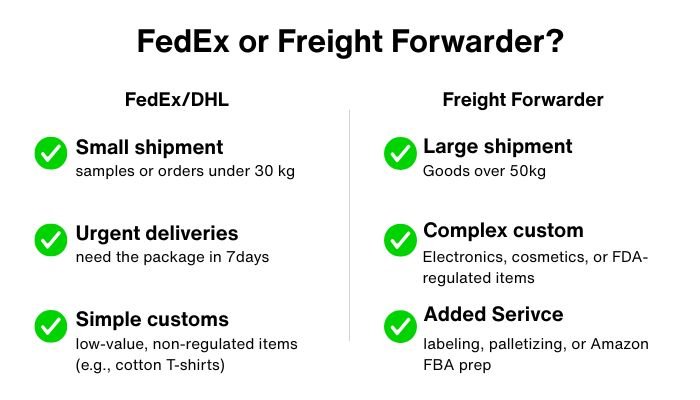
When FedEx/DHL Makes Sense
- Small Shipments: Sending samples or orders under 30 kg? Couriers are fast and hassle-free.
- Urgent Deliveries: Need a 5-pound package in the U.S. in 7 days? DHL’s express air service is perfect.
- Simple Customs: If your products are low-value, non-regulated items (e.g., cotton T-shirts), couriers handle basic customs clearance.
When a Freight Forwarder is Better
- Large Shipments: Shipping 100 kg of goods? Freight forwarders negotiate cheaper air/sea rates than couriers.
- Complex Customs: Electronics, cosmetics, or FDA-regulated items? Forwarders manage tricky paperwork and duties.
- Added Services: Need labeling, palletizing, or Amazon FBA prep? Forwarders bundle these services; couriers don’t.
Cost Example:
If you want to ship 2kg and 100kg of goods from Shenzhen to France, here is the differences:
| 2kg | 100kg | |
| FedEx | $40 | $2000 |
| Freight Forwarder | / | $180 |
*The costs here are for demonstration purposes only. There might be other actual costs.
The Bottom Line
Use FedEx/DHL for speed and simplicity with small packages(2 kg- 30 kg package, for example, a sample). Use a freight forwarder for bulk shipments, cost savings, and hands-on logistics support.
Why Partner with a Shenzhen-Based Freight Forwarder?
You could hire a forwarder from anywhere, but Shenzhen-based experts have unique advantages:
- They Speak the Local Language (Literally and Figuratively)
They know how to navigate Yantian Port’s busy schedules, haggle with local trucking companies, and communicate with Shenzhen customs officials—no Google Translate needed.
- They’ve Got Connections
Established forwarders have relationships with airlines, shipping lines, and warehouses. This means better rates and priority treatment during peak seasons (like Christmas).
- They Save You Time
Imagine trying to fill out Chinese customs forms at 2 a.m. while worrying about tariffs. A local forwarder handles this while you focus on your business.
- They Solve Problems Fast
If a typhoon delays your shipment or customs flags your paperwork, a Shenzhen forwarder can fix issues on the ground while you sleep.
6 Key Factors to Choose the Right Freight Forwarder
Not all forwarders are created equal. You can try the following factors as your selection standard. Here’s what to look for:
- Experience with Your Product Type
Shipping electronics? You need a forwarder who knows battery safety rules. Shipping perishables? Find one skilled in cold-chain logistics.
- Global Network + Local Partners
Ask: Do they work with major carriers like DHL or FedEx? Do they have warehouse partners near Shenzhen?
- Transparent Pricing
Avoid forwarders who give vague quotes. Demand a breakdown of costs: freight charges, customs fees, fuel surcharges, etc.
- Communication Skills
Can they explain complex terms in plain English? Do they reply to emails within 24 hours? Poor communication = big red flag.
- Good Reviews
Check Google, LinkedIn, or industry forums like Freightos for client feedback. Look for mentions of on-time delivery and problem-solving.
Questions to Ask When Selecting a Freight Forwarder in Shenzhen
Choosing the right freight forwarder is like hiring a business partner—you want someone reliable, transparent, and experienced. Before signing a contract, ask these 10 critical questions:
1. “Do you have experience shipping [my product type]?”
- Why it matters: Electronics, cosmetics, and food all have different regulations. A forwarder familiar with your niche avoids customs hiccups.
2. “What services do you include?”
- Look for: Customs clearance, FBA prep, warehousing, and door-to-door delivery. Avoid forwarders who nickel-and-dime you for basic services.
3. “Can you handle Amazon FBA requirements?”
- Key: They should know Amazon’s labeling, packaging, and delivery rules (e.g., PO number matching).
4. “What’s your process for resolving delays or damaged goods?”
- Red flags: Vague answers like “We’ll figure it out.” Green flags: Clear escalation steps and insurance options.
5. “How do you calculate costs? Are there hidden fees?”
- Demand a breakdown: Freight charges, fuel surcharges, customs duties, and documentation fees.
6. “Can you provide references from clients in my industry?”
- Bonus: Ask for case studies showing how they solved challenges (e.g., rerouting shipments during port strikes).
7. “What’s your communication style?”
- Ideal: A dedicated account manager who speaks English and responds within 24 hours.
8. “Do you have a licensed customs broker on your team?”
- Critical for avoiding seizures or fines due to incorrect HS codes or paperwork.
9. “What happens if customs inspect my shipment?”
- A good forwarder will handle inspections, pay temporary fees (if needed), and keep you updated.
10. “Can I see a sample contract?”
- Check terms for liability limits, insurance coverage, and cancellation policies.
How to Find a Freight Forwarder in Shenzhen in 6 Simple Steps
1. Start Online
Search for companies that have partnered with Amazon and Alibaba, such as Yanwen Express, the Shenzhen Chamber of Commerce or Alibaba Freight. Look for forwarders with “Shenzhen” in their location.
2. Ask for Referrals
Ask your supplier for recommendations. If they can handle the shipping for you, that’s perfect. You can also search for support forums on Amazon or Reddit. But do your due diligence review before signing any contract with them.
3. Interview Your Top 3 Choices
Ask:
- “Have you shipped [your product] before?”
- “Can you share references?”
- “What’s your process for handling delays?”
4. Compare Quotes
Don’t just pick the cheapest option—factor in reliability, compensation, and extra services(repacking, warehousing, etc). You may need it someday.
5. Visit Their Office (If Possible)
Well, I think it’s not very necessary. But some people may accuse me of irresponsibility if I don’t add this one. It’s great, though, if you are on a trip to Shenzhen. A physical office in Shenzhen means they’re invested in the area. Plus, you can meet the team face-to-face. But most of the time, you will see their warehouse, and people there are usually not very good at speaking English, so the trip might not be productive.
6. Start with a Small Shipment
Test their services with a trial order before signing a long-term contract. And see how they respond to your requirements.
Red Flags to Avoid
🚩 No Physical Address
They might be a scam if they’re based in a random apartment or won’t share their location.
🚩 “Too Good to Be True” Pricing
Super-low rates often mean hidden fees or terrible service.
🚩 Zero Reviews or References
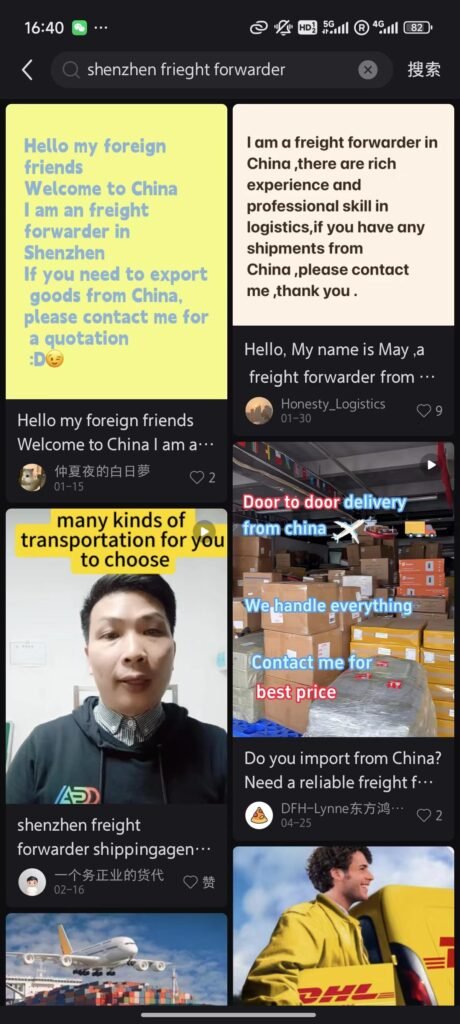
No reviews or references online(I mean in China’s search engine Baidu.com. Or app Little Red Book)
🚩 Pushy Sales Tactics
Reputable forwarders don’t pressure you to sign contracts immediately.
What If You Don’t Use a Freight Forwarder? 5 Alternatives
Maybe you’re on a tight budget or love DIY projects. Here’s how to ship from Shenzhen without a forwarder:
1. Work Directly with Carriers
Book space with airlines (China Southern, Cathay Pacific) or shipping lines (COSCO, Maersk).
- 👍 Pros: Full control over your shipment.
- 👎 Cons: You’ll need to handle customs paperwork yourself.
2. Use Online Freight Platforms
Websites like Freightos or Flexport let you compare quotes and book shipments instantly.
- 👍 Pros: Fast, transparent, and no haggling.
- 👎 Cons: Limited help if your cargo gets stuck at customs.
3. Ask Your Supplier to Ship for You
Many factories offer “FOB” (Free on Board) terms, meaning they’ll deliver goods to the port. This is my top recommendation.
- 👍 Pros: Saves time.
- 👎 Cons: You’ll still need someone to handle customs at your destination country.
4. DIY Customs Paperwork
File import/export declarations yourself using government portals.
- 👍 Pros: No forwarder fees.
- 👎 Cons: One typo could lead to fines or seized goods.
5. Hire a 3PL (Third-Party Logistics Provider)
3PLs manage warehousing and shipping but may lack Shenzhen-specific expertise.
Why This Is Risky: Without a forwarder, you’re on the hook for delays, damaged goods, or customs fines. One mistake could cost you thousands.
Conclusion: Always check before you decide
Finding a freight forwarder in Shenzhen is like hiring a guide for a jungle trek—they know the shortcuts, dangers, and how to carry the heavy stuff. Follow the steps above to choose a partner you trust.
But if you’re determined to ship solo, tread carefully. Double-check customs forms, buy insurance, and maybe keep a freight forwarder’s number on speed dial—just in case.
Need Help? I have over 5 years of experience dealing with Shenzhen forwarders. If you need some recommendations(just my choices), or have doubts or questions before shipping your products, feel free to ask me at jormauli2035@gmail.com
FAQ
- Q: How much does a freight forwarder cost?
- A: Typically 10-15% of shipping costs, but varies by cargo size and services.
- Q: Can I ship from China without a forwarder?
- A: Yes, but it’s riskier. Use online platforms or 3PLs for simpler shipments.